
Sorry, you need to enable JavaScript to visit this website.

SECTION 9.0 - CONSERVATION AND INCIDENTAL TAKE ESTIMATES

A Habitat Conservation Plan (HCP) is required to disclose impacts likely to result from the proposed Taking of species for which coverage is requested, and the HCP must also incorporate measures to minimize and mitigate the impacts of such Takings. This section presents overall impact and Take estimates associated with implementation of the MSHCP Plan. This section also summarizes measures incorporated in the MSHCP to minimize and mitigate the identified impacts, including conservation estimates. These measures are described in greater detail throughout the MSHCP Plan. For example, Section 3.0 of this document describes the MSHCP Conservation Area that will be assembled to offset the impacts of the proposed Taking. Section 5.0 of this document describes proposed management and monitoring efforts within the MSHCP Conservation Area. Section 6.0 discusses implementation measures incorporated in the Plan to minimize impacts and Section 7.0 incorporates measures to minimize impacts associated with specific Covered Activities. Taken together, these measures represent minimization of identified impacts to the maximum extent practicable as summarized at the end of this section (Section 9.3). 

    9.1 OVERALL CONSERVATION AND IMPACT ESTIMATES OF VEGETATION COMMUNITIES

    This Section provides the overall conservation and impact estimates for Vegetation Communities with implementation of the MSHCP. Table 9-1 summarizes anticipated Conservation and loss of the Vegetation Communities within the Plan Area. In general, the MSHCP tends to protect more sensitive upland, wetland and forest Vegetation Communities that support a larger number of sensitive species in the Plan Area.

    Vegetation Communities may be considered within four broad categories: sensitive upland, wetland, forest and Agriculture. Sensitive upland communities include chaparral, coastal sage scrub, desert scrub, grassland and Riversidean alluvial fan sage scrub. Wetland communities include meadows and marshes, playas and vernal pools, riparian scrub/woodland/forest, cismontane alkali marsh and water. Forest communities include montane coniferous forest, and woodlands and forests. As shown inTable 9-1, implementation of the MSHCP generally would result in the greatest amount of protection for sensitive upland, wetland and forest communities because these Vegetation Communities generally tend to support a broader assemblage of sensitive species.

    TABLE 9-1
    OVERALL VEGETATION COMMUNITY
    CONSERVATION AND IMPACT ESTIMATES
    Vegetation CommunityTotal Acres
    in Plan Area*
    Total Acres
    Conserved
    Percent of Total
    Vegetation Community Acres
    Conserved in
    Plan Area
    Total Acres
    Potentially Affected*
    Percent of Total
    Vegetation Community Acres
    Potentially Affected in Plan Area
    Agriculture169,48020,02012%149,46088%
    Chaparral434,950272,28063%162,67037%
    Cismontane Alkali Marsh1,260403%1,22097%
    Coastal Sage Scrub156,45081,72052%74,73048%
    Desert Scrubs14,5704,99034%9,58066%
    Grassland154,14042,82028%111,32072%
    Meadows and Marshes1,02051050%51050%
    Montane Coniferous Forest29,91020,50069%9,41031%
    Playas and Vernal Pools7,9106,75085%1,16015%
    Riparian Scrub, Woodland, Forest15,03011,19074%3,84026%
    Riversidean Alluvial Fan Sage Scrub7,9405,23066%2,71034%
    Unknown1,3501,24092%1108%
    Water12,21010,34085%1,87015%
    Woodlands and Forests34,30023,50069%10,80031%
    Developed or Disturbed Land218,2604,7802%213,48098%
    TOTALS1,258,780505,910 752,870 

    * This includes the following acreages of each Vegetation Community on American Indian Lands that, while within the Plan Area, are not a part of the Plan:

    Agriculture:1,110
    Chaparral:20,290
    Cismontane Alkali Marsh:1,110
    Coastal Sage Scrub:3,760
    Desert Scrubs:5,190
    Grasslands:7,260
    Meadows and Marshes:50
    Montane Coniferous Forest:10
    Riparian Scrub, Woodland, Forest:420
    Riversidean Alluvial Fan Sage Scrub:790
    Unknown:10
    Water:10
    Woodlands and Forests:1,050
    Developed or Disturbed Land:510

    Anticipated impacts to coastal sage scrub, desert scrub, grassland, cismontane alkali marsh, and meadows and marshes under the MSHCP Plan would result in a substantial reduction of sensitive Vegetation Communities within the Plan Area. Impacts to these Vegetation Communities would also have substantial adverse effects on listed, sensitive, or special status species that occupy and utilize these Vegetation Communities. For example, a substantial reduction of coastal sage scrub Habitat would adversely affect listed and other sensitive species, such as the coastal California gnatcatcher, through habitat modification. Inclusion of a large percentage of chaparral within the MSHCP Conservation Area would reduce identified impacts to this community given the extensive acreage and wide distribution of this Vegetation Community in the Plan Area and the relatively low number of listed species preferring this Vegetation Community within the Plan Area. A majority of the playas and vernal pools and riparian scrub/woodland/forest wetland communities would be conserved. In general, inclusion of the majority of the forest communities as Conserved Habitat within the MSHCP Conservation Area would minimize identified impacts to these communities. Although not a sensitive Vegetation Community, impacts to agricultural land would cause a substantial reduction of this community and would also adversely affect sensitive species that occupy or utilize agricultural lands including raptors and burrowing mammals.

    Anticipated impacts to Vegetation Communities may be contrasted with the anticipated Conservation shown in Table 9-1. As described in this Plan, Conservation would occur within an appropriately designed, managed and funded MSHCP Conservation Area consistent with overall and species-specific conservation objectives.

    9.2 COVERED SPECIES

    This section provides the overall conservation and impact estimates for Covered Species under the MSHCP Plan. In addition to describing the Conservation Strategy developed for each of the Covered Species, maps and definitions are provided or referenced to facilitate review of the species Conservation and impact summary contained in this section. Comprehensive analyses of the Covered Species are located in the Species Accounts in Section B of the MSHCP Reference Document, Volume II.

    Conservation Strategy

    The MSHCP will implement a Conservation Strategy for each of the Covered Species. The Conservation Strategy for each species consists of four components: (1) a global biological goal, (2) global biological objectives, (3) species-specific biological objectives, and (4) management and monitoring activities (as referenced in global biological objective #11).

    (1) Global Biological Goal

    The following global biological goal applies to the Conservation of each of the MSHCP Covered Species:

    In the MSHCP Plan Area, Conserve Covered Species and their Habitats.

    (2) Global Biological Objectives

    The following global biological objectives shall be implemented for the benefit of the MSHCP Covered Species in order to achieve the global biological goal:

    Amphibians:

    1. The MSHCP Conservation Area shall be approximately 500,000 acres in size and shall be comprised of approximately 347,000 acres of Public/Quasi-Public Lands and approximately 153,000 acres of Additional Reserve Lands. The MSHCP Conservation Area shall incorporate the Cores and Linkages as well as habitat distributions generally as presented in the MSHCP Conservation Area Description in Section A of theMSHCP Reference Document, Volume II.
    2. Upland habitat quality within the MSHCP Conservation Area shall be maintained and managed generally in similar or better condition as at the time lands are conveyed to the MSHCP Conservation Area.
    3. Wetland habitat quality within the MSHCP Conservation Area shall be maintained and managed generally in similar or better condition as at the time lands are conveyed to the MSHCP Conservation Area.
    4. Best Management Practices (BMPs) shall be implemented in accordance with the guidelines presented in Appendix C of this document. For Flood Control projects, the existing NPDES general permit for storm water discharges associated with construction activities (Water Quality Order 99-08-DWQ) and Section 1601 Streambed Alteration Agreement for flood control facilities maintenance shall be implemented.
    5. New land uses adjacent to the MSHCP Conservation Area shall implement the Guidelines Pertaining to the Urban/Wildlands Interface presented in Section 6.1.4 of this document.
    6. The Maintenance of Existing Habitat Conditions Prior to Reserve Assembly policies presented in Section 6.1.5 of this document shall be implemented to ensure that habitat quality within the Criteria Area generally remains in its existing condition prior to conveyance of lands to the MSHCP Conservation Area.
    7. The Protection of Species Associated with Riparian/Riverine Areas and Vernal Pools policies presented in Section 6.1.2 of this document shall be implemented for the benefit of the following species. Other species survey requirements associated with the MSHCP are documented in Section 6.1.3 and 6.3.2 of this document. A complete summary of all MSHCP species survey requirements is provided in Appendix E to this document.
    • arroyo toad
    • California red-legged frog
    • coast range newt
    • mountain yellow-legged frog
    • western spadefoot

    Birds:

    • American bittern
    • bald eagle
    • black-crowned night-heron
    • black swift
    • Cooper's hawk
    • double-crested cormorant
    • downy woodpecker
    • least Bell's vireo
    • Lincoln's sparrow
    • MacGillivray's warbler
    • Nashville warbler
    • osprey
    • peregrine falcon
    • purple martin
    • southwestern willow flycatcher
    • tree swallow
    • tricolored blackbird
    • western yellow-billed cuckoo
    • white-faced ibis
    • white-tailed kite
    • Wilson's warbler
    • yellow-breasted chat
    • yellow warbler

    Fish:

    • arroyo chub
    • Santa Ana sucker

    Invertebrates:

    • Riverside fairy shrimp
    • Santa Rosa Plateau fairy shrimp
    • vernal pool fairy shrimp

    Plants:

    • Brand's phacelia
    • California black walnut
    • California muhly
    • California Orcutt grass
    • Coulter's goldfields
    • Coulter's matilija poppy
    • Davidson's saltscale
    • Engelmann oak
    • Fish's milkwort
    • graceful tarplant
    • lemon lily
    • little mousetail
    • Mojave tarplant
    • mud nama
    • ocellated Humboldt lily
    • Orcutt's brodiaea
    • Parish's brittlescale
    • Parish's meadowfoam
    • prostrate navarretia
    • San Diego button-celery
    • San Jacinto Valley crownscale
    • San Miguel savory
    • Santa Ana River woolly-star
    • slender-horned spine flower
    • smooth tarplant
    • spreading navarretia
    • thread-leaved brodiaea
    • vernal barley
    • Wright's trichocoronis

    Reptiles:

    • western pond turtle
    • The Protection of Narrow Endemic Plant Species policies presented in Section 6.1.3 of this document shall be implemented for the benefit of the following species. Other species survey requirements associated with the MSHCP are documented in Section 6.1.3 and 6.3.2. of this document A complete summary of all MSHCP species survey requirements is provided in Appendix E to this document.
    • Brand's phacelia
    • California Orcutt grass
    • Hammitt's clay-cress
    • Johnston's rock-cress
    • many-stemmed dudleya
    • Munz's mariposa lily
    • Munz's onion
    • San Diego ambrosia
    • San Jacinto Mountains bedstraw
    • San Miguel savory (Santa Rosa Plateau, Steele Rock)
    • slender-horned spine flower
    • spreading navarretia
    • Wright's trichocoronis
    • Yucaipa onion
    • The Additional Survey Needs and Procedures policies presented in Section 6.3.2 of this document shall be implemented for the benefit of the following species. Other species survey requirements associated with the MSHCP are documented in Section 6.1.3 and 6.3.2. of this document A complete summary of all MSHCP species survey requirements is provided in Appendix E to this document.

    Amphibians:

    • arroyo toad
    • California red-legged frog
    • mountain yellow-legged frog

    Birds:

    • burrowing owl

    Mammals:

    • Aguanga kangaroo rat
    • Los Angeles pocket mouse
    • San Bernardino kangaroo rat

    Plants:

    • Coulter's goldfields
    • Davidson's saltscale
    • heart-leaved pitcher sage
    • little mousetail
    • mud nama
    • Nevin's barberry
    • Parish's brittlescale
    • prostrate navarretia
    • round-leaved filaree
    • San Jacinto Valley crownscale
    • smooth tarplant
    • thread-leaved brodiaea
    • Vail Lake ceanothus
    • Covered Activities within the Criteria Area and Allowable Uses within the MSHCP Conservation Area shall be implemented in accordance with the siting, construction, design, operations and maintenance guidelines included in Section 7.0 of this document.
    • Monitoring and management activities shall be undertaken for each of the MSHCP Covered Species. Monitoring and management activities are described in Sections 5.2 and 5.3 of this document.

    (3) Species-Specific Biological Objectives

    Species-specific biological objectives have been established for each of the Covered Species in the MSHCP. Species-specific objectives are presented in each of the individual species accounts contained in Section B of the MSHCP Reference Document, Volume II and in Table 9-2 presented later in this section. The quantitative information presented in these accounts sets the overall parameters for species Conservation and Reserve Assembly, but should not be regarded as absolute. Some variation in the quantifications is anticipated as the Additional Reserve Lands are assembled to provide for flexibility in Reserve Assembly and to enable responses to changing conditions on the ground during the long-term Reserve Assembly process. Additionally, the species conservation levels are preliminary and may be modified based on future data collection efforts and as jointly agreed upon by the affected Permittees and the Wildlife Agencies.

    In the individual species accounts, each species has been assigned a group designation - Group 1, Group 2 or Group 3. These species groupings, which are based on the group definitions incorporated in the Natural Communities Conservation Planning Act, have been assigned to assist development of individual species objectives as well as monitoring and management requirements for the MSHCP. The three group definitions are as follows:

    Group 1 -- Take coverage is warranted based upon regional or landscape level considerations, such as healthy population levels, widespread distribution throughout the MSHCP Plan Area, and life history characteristics that respond to habitat-scale conservation and management actions.

    Group 2 -- Take coverage is warranted based on regional or landscape level considerations with the addition of site-specific conservation and management requirements that are clearly identified in the MSHCP for species that are generally well-distributed, but that have Core Areas that require Conservation.

    Group 3 -- Take coverage is warranted based upon site specific considerations and the identification of specific conservation and management conditions for species within a narrowly defined Habitat or limited geographic area within the MSHCP Plan Area.

    (4) Monitoring and Management Activities

    Monitoring and management activities have been identified for each of the Covered Species as presented in Sections 5.2 and 5.3 of this document.

    Species Accounts Maps

    Maps have been prepared to accompany the species Conservation and Take summary presented in this section. These maps contain the following information:

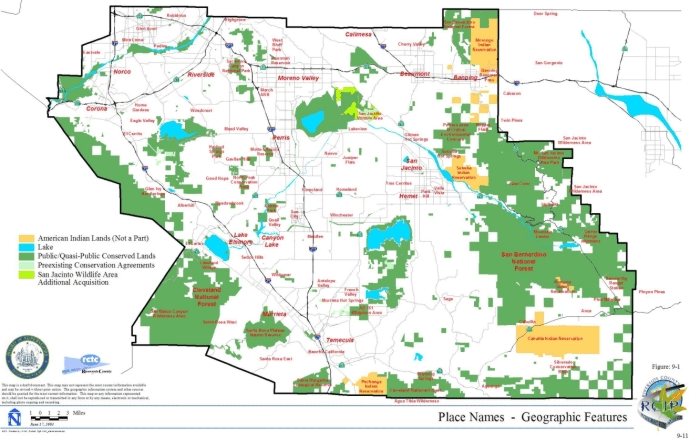
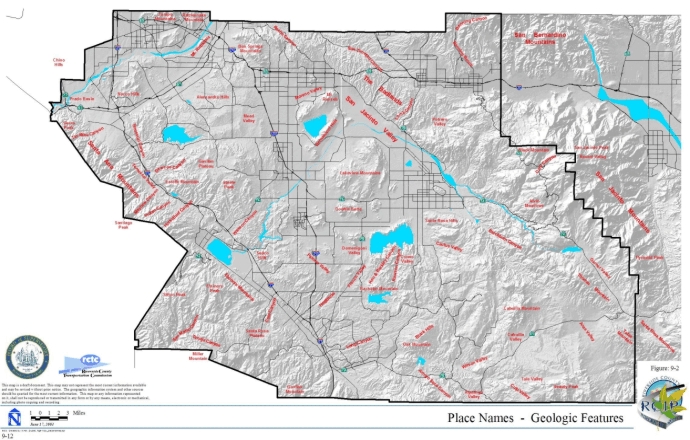
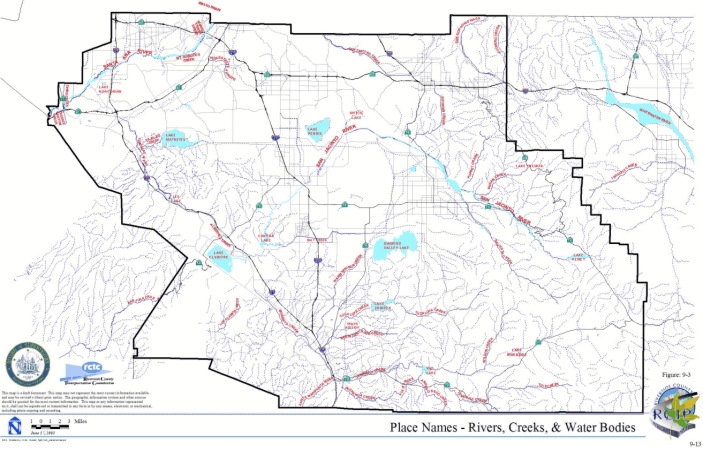
    Figures 9-1, 9-2, and 9-3 -- Place Name Maps -These maps show the locations of place names referenced in the individual species accounts. Three place names maps are provided: Geographic Place Names, Geologic Features, and Rivers, Creeks and Water Bodies.

    Figures 9-4, 9-5, 9-6, 9-7 and 9-8 -- Criteria Area Maps - The MSHCP Criteria Area generally depicts the area from which Additional Reserve Lands will be assembled. The following maps have been prepared to depict the relationship of the Criteria Area to various analysis factors referenced in the species accounts (the data sources for the analysis factors shown on the maps are summarized in Sections 2.1.1, 2.1.2 and 2.1.3):


    • Criteria Area with Bioregions
    • Criteria Area with coastal sage scrub habitat quality
    • Criteria Area with mapped wetland resources
    • Criteria Area with sensitive soils
    • Criteria Area with elevations

    In addition to the figures noted above, two other maps will facilitate review of the species Conservation and Take summary presented in this section. Numbered and lettered Cores and Linkages, shown in Figure 3-2 (the Core and Linkage Map) and referenced in the individual species accounts, depict existing and proposed Cores and Linkages within the MSHCP Conservation Area. Numbered Area Plan Subunits, which are referenced in the individual species accounts when defining units of measurement for some individual species objectives, are depicted in Figure 3-3 (the Area Plan Subunits Map) and defined more specifically in Section 3.3 of this document.

    Definitions

    Where specific or unique definitions have been developed for use in the MSHCP and may be referenced in the species accounts, those definitions are provided following the Table of Contents in this document. For other biological terms, refer to the following suggested references:

    Lincoln, R.G. Boxshall, and P. Clark. 1998. A Dictionary of Ecology, Evolution and Systematics, Second Edition, Cambridge University Press, 361. Pp.

    Steen, E.G. 1971. Dictionary of Biology. Barnes & Noble Books, San Francisco, 640 pp.

    Species Conservation and Take Summary

    Anticipated Conservation and Take of Covered Species are summarized in Table 9-2 and presented in detail in Section B of the MSHCP Reference Document, Volume II. Table 9-2 includes the 146 species anticipated to be covered under the MSHCP Plan and is separated into nine columns: Species Name (common/scientific), Group Designation, Rationale for Group Designation, Species Objectives, Conservation Analysis Summary, Incidental Take, Survey Requirements, Monitoring, and Management Activities Summary. In addition to providing the group designation, the rationale for the group designation is also provided for each of the Covered Species. The Species Objectives and Conservation Analysis Summary columns explain the measures that will be taken to conserve the Covered Species with implementation of the MSHCP Plan. The Incidental Take column summarizes the anticipated Take of Covered Species with implementation of the Plan. The Survey Requirements column identifies whether a survey must be conducted for a particular species and references the section of the MSHCP Plan where survey requirements are more specifically defined. The Monitoring column incorporates information from Table 5-8 in Section 5.3 of this document including monitoring frequency for assessment of species distribution and reproduction. Finally, the Management Activities column summarizes specific management activities that will be performed for each species. The General Management measures referenced in this column are presented in Section 5.2 of this document.

    As described in Section 2.1.4, of the 146 Covered Species addressed in the MSHCP, 118 species are considered to be adequately conserved. The remaining 28 Covered Species will be considered to be adequately conserved when certain conservation requirements are met as identified in the species-specific conservation objectives for those species. For 16 of the 28 species, particular species-specific conservation objectives, which are identified in Table 9-3, must be satisfied to shift those particular species to the list of Covered Species Adequately Conserved. For the remaining 12 species, a Memorandum of Understanding must be executed with the Forest Service that addresses management for these species on Forest Service Land in order to shift these species to the list of Covered Species Adequately Conserved. More complete information regarding these 28 species is also included in Table 9-2, which summarizes anticipated Conservation and Take of the 146 Covered Species as described above.

    TABLE 9-3
    REQUIREMENTS TO BE MET FOR 28 SPECIES PRIOR TO INCLUDING THOSE SPECIES ON THE LIST OF COVERED SPECIES ADEQUATELY CONSERVED1
    COMMON NAME/
    SCIENTIFIC NAME
    REQUIREMENT
    REPTILES
    BIRDS
    MAMMALS
    PLANTS
    San Bernardino mountain kingsnake
    Lampropeltis zonata parvirubra
    In order for this species to become a Covered Species Adequately Conserved, a Memorandum of Understanding must be executed with the Forest Service that addresses management for this species on Forest Service Land.
    San Diego mountain kingsnake
    Lampropeltis zonata pulchra
    In order for this species to become a Covered Species Adequately Conserved, a Memorandum of Understanding must be executed with the Forest Service that addresses management for this species on Forest Service Land.
    southern rubber boa
    Charina bottae umbratica
    In order for this species to become a Covered Species Adequately Conserved, a Memorandum of Understanding must be executed with the Forest Service that addresses management for this species on Forest Service Land.
    southern sagebrush lizard
    Sceloporus graciosus vandenburgianus
    In order for this species to become a Covered Species Adequately Conserved, a Memorandum of Understanding must be executed with the Forest Service that addresses management for this species on Forest Service Land.
    California spotted owl
    Strix occidentalis occidentalis
    In order for this species to become a Covered Species Adequately Conserved, a Memorandum of Understanding must be executed with the Forest Service that addresses management for this species on Forest Service Land.
    grasshopper sparrow
    Ammodramus savannarum
    Species Specific Conservation Objective: Within the MSHCP Conservation Area, maintain occupancy within 3 large Core Areas (100 percent) and at least 3 of the 4 smaller Core Areas (75 percent) in at least 1 year out of any 5 consecutive year period. In order for this species to become a Covered Species Adequately Conserved, the following conservation must be demonstrated: Include within the MSHCP Conservation Area at least 8,000 acres in 7 Core Areas. Core areas may include the following: 1) Prado Basin, 2) Lake Skinner/Diamond Valley Lake/Johnson Ranch area, 3) Lake Mathews-Estelle Mountain, 4) Badlands, 5) Box Springs, 6) Santa Rosa Plateau/Tenaja, 7) Kabian Park, 8) Steele Peak, 9) Sycamore Canyon, 10) Potrero, and 11) Mystic Lake/San Jacinto Wildlife Area. Three of the 7 Core Areas will be large, consisting of a minimum of 2,000 acres of grassland habitat or grassland-dominated habitat (<20 percent shrub cover). The other 4 Core Areas may be smaller but will consist of at least 500 acres of contiguous grassland habitat or grassland-dominated habitat (<20 percent shrub cover). Five of the 7 Core Areas will be demonstrated to support at least 20 grasshopper sparrow pairs with evidence of successful reproduction within the first 5 years after permit issuance. Successful reproduction is defined as a nest which fledged at least one known young.
    Lincoln's sparrow (breeding)
    Melospiza lincolnii
    Species Specific Conservation Objective: Within the MSHCP Conservation Area, maintain occupancy within 3 large Core Areas (100 percent) in at least 1 year out of any 5 consecutive-year period. In order for this species to become a Covered Species Adequately Conserved, the following conservation must be demonstrated: Include within the MSHCP Conservation Area at least 100 acres in 3 Core Areas. Core Areas may include the following: (1) Tahquitz Valley; (2) Round Valley; (3) Garner Valley. The three Core Areas will be large, consisting of a minimum of 50 acres of montane meadow, wet montane meadow, and edges of montane riparian or riparian scrub. The Core Areas will be demonstrated to support at least 20 Lincoln's sparrow pairs with evidence of successful reproduction within the first 5 years after permit issuance. Successful reproduction is defined as a nest which fledged at least one known young.
    Williamson's sapsucker
    Sphyrapicus thyroideus
    In order for this species to become a Covered Species Adequately Conserved, a Memorandum of Understanding must be executed with the Forest Service that addresses management for this species on Forest Service Land.
    San Bernardino flying squirrel
    Glaucomys sabrinus californicus
    Species Specific Conservation Objective: In order for this species to become a Covered Species Adequately Conserved, the following conservation must be demonstrated: Within the MSHCP Conservation Area, confirm occupation of 1000 ha (2470 acres) with a mean density of at least 2 individuals per hectare (2 individuals per 2.47 acres) in the San Jacinto mountains; and in the San Bernardino Mountains confirm occupation of 100 ha.
    beautiful hulsea
    Hulsea vestita ssp. callicarpha
    Species Specific Conservation Objective: In order for this species to become a Covered Species Adequately Conserved, the following conservation must be demonstrated: Within the MSHCP Conservation Area, confirm 16 localities (locality in this sense is not smaller than one quarter section) with no fewer than 50 individuals each (unless a smaller population has been demonstrated to be self-sustaining).
    California bedstraw
    Galium californicum ssp. primum
    In order for this species to become a Covered Species Adequately Conserved, a Memorandum of Understanding must be executed with the Forest Service that addresses management for this species on Forest Service Land.
    California muhly
    Muhlenbergia californica
    Species Specific Conservation Objective: In order for this species to become a Covered Species Adequately Conserved, the following conservation must be demonstrated: Within the MSHCP Conservation Area, confirm 10 localities (locality in this sense is not smaller than one quarter section) containing at least 50 clumps (unless a smaller population has been demonstrated to be self-sustaining).
    chickweed oxytheca
    Oxytheca caryophylloides
    Species Specific Conservation Objective: In order for this species to become a Covered Species Adequately Conserved, the following conservation must be demonstrated: Within the MSHCP Conservation Area, confirm 10 localities (locality in this sense is not smaller than one quarter section) managed with 1,000 individuals each (unless a smaller population has been demonstrated to be self-sustaining).
    Cleveland's bush monkeyflower
    Mimulus clevelandii
    In order for this species to become a Covered Species Adequately Conserved, a Memorandum of Understanding must be executed with the Forest Service that addresses management for this species on Forest Service Land.
    cliff cinquefoil
    Potentilla rimicola
    Species Specific Conservation Objective: In order for this species to become a Covered Species Adequately Conserved, the following conservation must be demonstrated: Within the MSHCP Conservation Area, confirm five localities (locality in this sense is not smaller than one quarter section).
    Coulter's matilija poppy
    Romneya coulteri
    Species Specific Conservation Objective: In order for this species to become a Covered Species Adequately Conserved, the following conservation must be demonstrated: Within the MSHCP Conservation Area, confirm 30 localities (locality in this sense is not smaller than one quarter section).
    Fish's milkwort
    Polygala cornuta var. fishiae
    Species Specific Conservation Objective: In order for this species to become a Covered Species Adequately Conserved, the following conservation must be demonstrated: Within the MSHCP Conservation Area, confirm 10 localities (locality in this sense is not smaller than one quarter section) with at least 50 individuals (ramets or genets) each (unless a smaller population has been demonstrated to be self-sustaining).
    graceful tarplant
    Holocarpha virgata ssp. elongata
    Species Specific Conservation Objective: In order for this species to become a Covered Species Adequately Conserved, the following conservation must be demonstrated: Within the MSHCP Conservation Area, confirm 10 localities (locality in this sense is not smaller than one quarter section) with 1,000 individuals each (unless a smaller population has been demonstrated to be self-sustaining).
    lemon lily
    Lilium parryi
    In order for this species to become a Covered Species Adequately Conserved, a Memorandum of Understanding must be executed with the Forest Service that addresses management for this species on Forest Service Land.
    Mojave tarplant
    Deinandra mohavensis
    Species Specific Conservation Objective: In order for this species to become a Covered Species Adequately Conserved, the following conservation must be demonstrated: Include within the MSHCP Conservation Area at least four localities (locality in this sense is not smaller than one quarter section) occupying at least 100 acres.
    ocellated Humboldt lily
    Lilium humboldtii ssp. ocellatum
    In order for this species to become a Covered Species Adequately Conserved, a Memorandum of Understanding must be executed with the Forest Service that addresses management for this species on Forest Service Land.
    Parry's spine flower
    Chorizanthe parryi var. parryi
    Species Specific Conservation Objective: In order for this species to become a Covered Species Adequately Conserved, the following conservation must be demonstrated: Within the MSHCP Conservation Area, confirm 10 localities (locality in this sense is not smaller than one quarter section) with at least 1,000 individuals (unless a smaller population has been demonstrated to be self-sustaining).
    peninsular spine flower
    Chorizanthe leptotheca
    Species Specific Conservation Objective: In order for this species to become a Covered Species Adequately Conserved, the following conservation must be demonstrated: Within the MSHCP Conservation Area, confirm 10 localities (locality in this sense is not smaller than one quarter section) with at least 1,000 individuals (unless a smaller population has been demonstrated to be self-sustaining).
    Plummer's mariposa lily
    Calochortus plummerae
    Species Specific Conservation Objective: In order for this species to become a Covered Species Adequately Conserved, the following conservation must be demonstrated: Within the MSHCP Conservation Area, confirm six localities (locality in this sense is not smaller than one quarter section) of at least 500 individuals each (unless a smaller population has been demonstrated to be self-sustaining).
    Rainbow manzanita
    Arctostaphylos rainbowensis
    Species Specific Conservation Objective: In order for this species to become a Covered Species Adequately Conserved, the following conservation must be demonstrated: Within the MSHCP Conservation Area, confirm 10 localities (locality in this sense is not smaller than one quarter section) with more than 50 individuals each (unless a smaller population has been demonstrated to be self-sustaining).
    shaggy-haired alumroot
    Heuchera hirsutissima
    In order for this species to become a Covered Species Adequately Conserved, a Memorandum of Understanding must be executed with the Forest Service that addresses management for this species on Forest Service Land.
    small-flowered microseris
    Microseris douglasii var. platycarpha
    Species Specific Conservation Objective: In order for this species to become a Covered Species Adequately Conserved, the following conservation must be demonstrated: Within the MSHCP Conservation Area, confirm 10 localities (locality in this sense is not smaller than one quarter section) with at least 1,000 individuals (unless a smaller population has been demonstrated to be self-sustaining).
    sticky-leaved dudleya
    Dudleya viscida
    In order for this species to become a Covered Species Adequately Conserved, a Memorandum of Understanding must be executed with the Forest Service that addresses management for this species on Forest Service Land.
    Notes:
    1 The species-specific conservation objectives listed in this table comprise only a portion of the objectives that must be satisfied for each species. The objectives summarized in Table 9-2 and presented in detail in the species accounts of the MSHCP Reference Document, Volume II must also be fulfilled for each species.


    9.3 MINIMIZATION AND MITIGATION MEASURES

    Minimization and mitigation measures incorporated in the MSHCP Plan are presented in detail throughout this document and the accompanying Reference Document - Volume II of the MSHCP. This section summarizes and references those measures. Minimization and mitigation measures have been incorporated in the MSHCP planning process and will be implemented during the long-term MSHCP implementation process. The various points in the process during which minimization and mitigation measures were and should be considered are listed below:

    • during the alternatives development and conservation planning process;
    • during the development of implementation procedures and strategies;
    • during Reserve Assembly activities;
    • during long-term management and monitoring activities.

    As part of the alternatives development and conservation planning process, as discussed in detail in Sections 2.0 and 3.4 of this document, a variety of alternatives and conservation planning strategies were considered to minimize the likely effects on Covered Species of anticipated growth in Western Riverside County. Of the four alternatives considered in detail, local stakeholders and decision makers selected Alternative 1, the alternative addressing conservation needs for the greatest number of species and the largest MSHCP Conservation Area. Also, as part of the conservation planning process, the circulation element required to accommodate projected growth was analyzed in the context of conservation goals. Certain roads or road extensions were eliminated from the circulation element or realigned in order to minimize impacts to Covered Species including the following: Keller, Baxter, De Portola, Del Rio, Avenida la Cresta, Calle Contento, Murrieta Hot Springs, Nicolas, Cactus Valley, Dunlap, Antelope Dawson, Newport, Estelle Mountain, Melanie, Indian Truck Trail, Castile, Hixon, Gibble, Fairview, Orange, Reservoir, Pico, 9th, B Street, and 10th.

    A Modified Reserve Design alternative was considered during the conservation planning process. It was determined that this alternative did not provide for substantially greater Conservation of Covered Species than would occur with the proposed Plan. This alternative was determined to be infeasible as part of a screening process. The screening analysis is documented in the Alternatives Screening Report included in the Appendix to the EIR/EIS for the MSHCP Plan and includes a description of the Modified Reserve Design alternative as well as a discussion of the reasons why the alternative was not carried forward for further analysis. While the Modified Reserve Design alternative would not provide for Conservation of species in addition to the 146 anticipated to be conserved under the MSHCP Plan, it would provide for a larger MSHCP Conservation Area and broader Linkages. A substantial amount of the additional Conservation provided under this alternative would be within areas designated for urban levels of Development and would thus conflict with local land use plans.

    A variety of implementation procedures and strategies are incorporated in the MSHCP to minimize and mitigate impacts to Covered Species. These procedures and strategies are described in detail in Sections 6.0 and 7.0 of this document and include elements such as the following - avoidance and minimization; survey requirements for certain species and associated avoidance and minimization requirements; criteria for siting, design, construction, operations and maintenance for Covered Activities incorporating avoidance and minimization requirements; and measures to ensure that indirect effects associated with land uses in proximity to the MSHCP Conservation Area are minimized.

    Likewise, a variety of measures are incorporated in the MSHCP Plan during the long-term Reserve Assembly process to ensure that the MSHCP Conservation Area is assembled in a manner consistent with MSHCP conservation goals and that the most appropriate lands are assembled for the MSHCP Conservation Area. These measures include requirements for prioritization of acquisitions, use of new information obtained as a result of surveys to focus acquisition efforts, guidelines to ensure that Reserve Assembly occurs in general Rough Step with Take of Covered Species, and assurances of adequate funding for Reserve Assembly.

    Comprehensive management and monitoring activities also will be undertaken during the life of the MSHCP Permit as described in Section 5.0 of this document. The monitoring and management plans are designed to address identified threats to Covered Species and to be consistent with MSHCP conservation objectives that call for establishment of a functioning, self-sustaining MSHCP Conservation Area.

    Mitigation measures incorporated in the Plan to compensate for Take of Covered Species that cannot be avoided or minimized, and to be undertaken by the Permittees include contribution of approximately 103,000 acres to the MSHCP Conservation Area and adherence to the requirements of the MSHCP. In addition, the Permittees will contribute to long-term management and monitoring of the MSHCP Conservation Area. These contributions are described in greater detail in Section 8.0 of this document.

    TABLE 9-2 - SPECIES CONSERVATION SUMMARY

    Click here for Table 9-2